
When people think of survival, they usually imagine size, strength, speed. Big jaws. Sharp claws. Power.
But the forest tells a very different story — one whispered at ground level, beneath leaves, inside bark, and along the thin edge of a stem.
The smallest lives often carry the most sophisticated strategies.
In the world I spend my time observing — insects, spiders, amphibians, fungi — survival is not about domination. It is about attention, adaptation, and relationship.
A walking stick insect does not fight. It becomes absence.
A moth does not run. It trusts in pattern and shadow.
A frog does not overpower its predator. It warns, deceives, or disappears.
To live small is not to live weak.
It is to live precisely.
Camouflage: The Art of Not Being Seen
Camouflage is often misunderstood as invisibility. In reality, it is a conversation with the environment.
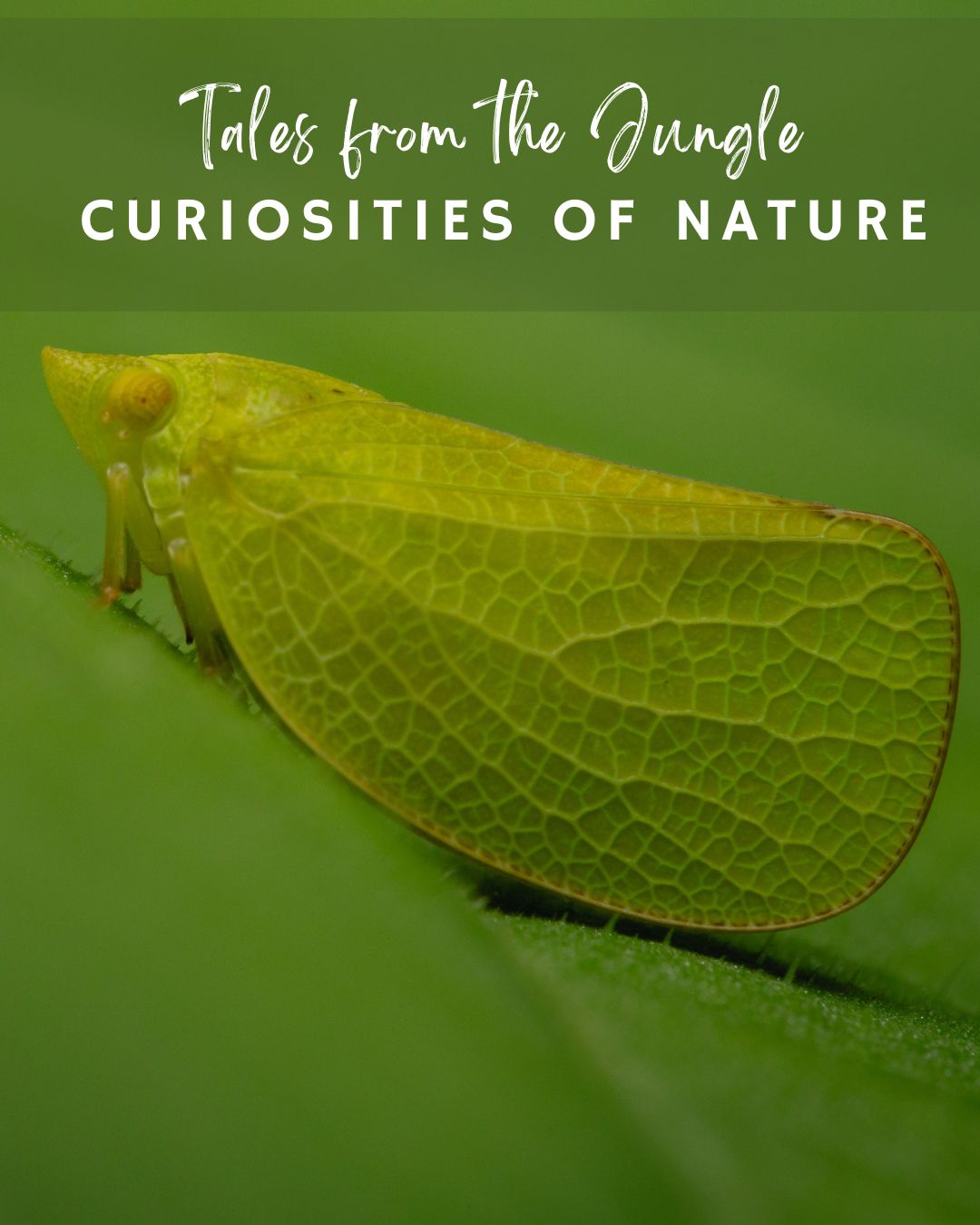
A leaf-mimicking katydid does not simply “look like a leaf.” It matches texture, veins, imperfections, even the illusion of decay. Some carry false bite marks. Others sway gently, mimicking the movement of foliage in the wind.
This is not coincidence.
This is evolution responding, again and again, to the question: How do I remain?
Camouflage teaches patience. It reminds us that survival does not always require action — sometimes it requires restraint. Stillness. Trust in context.
In a world that rewards constant visibility, these creatures survive by knowing when not to be noticed.

Plant hopper / Cynthia Bandurek
Mimicry: Survival Through Storytelling
Some species survive by telling convincing lies.
Harmless flies wear the warning colors of wasps.
Non-venomous snakes borrow the language of danger.
Soft-bodied insects imitate thorns, ants, or even bird droppings.
Mimicry is storytelling written into the body — a visual sentence that says: I am not worth the risk.
What fascinates me most is that these strategies only work because of memory. A predator must have learned, at some point, that certain colors or shapes come with consequences. Survival here is communal, indirect, dependent on shared experience.
No creature survives alone. Even deception relies on relationship.

Chemical Defenses: When Beauty Warns
Bright colors in nature are rarely decoration. They are declarations.
Aposematism — the use of bold colors to signal toxicity or unpalatability — is one of the clearest examples of honesty in the natural world. Poison dart frogs, chemically protected beetles, vividly patterned caterpillars are not hiding. They are saying: I am not safe to eat.
This strategy is costly. Being visible increases risk. But it also reduces unnecessary conflict. Once the message is learned, predators look away.
There is wisdom here.
Not all protection comes from hiding. Sometimes it comes from clarity.

Timing, Not Speed
Many small creatures survive not by moving fast, but by moving at the right moment.
Some insects emerge only for a few hours a year.
Others synchronize their life cycles with rain, moonlight, or flowering events.
Some remain dormant — eggs, spores, pupae — waiting weeks, months, even years for the right conditions.
Time is a tool.
In tropical forests especially, survival is about reading signals: humidity, temperature, vibration, scent. Life unfolds in rhythms invisible to hurried eyes.
Watching this teaches humility. The forest is not slow. We are.
Fragility Is Not Failure
People often describe small animals as “fragile.” But fragility is not the opposite of resilience. It is often the result of specialization.
These organisms have evolved to fit narrow niches with astonishing precision. When conditions are right, they thrive. When systems are disrupted, they suffer — not because they are weak, but because they are finely tuned.
Their vulnerability is a mirror.
It reflects the health of the ecosystem itself.
When small lives disappear, something much larger is breaking.

What the Small World Teaches Us
Spending time with these creatures has quietly changed the way I understand strength.
Strength can be subtle.
Protection can be gentle.
Persistence can look like waiting.
The small world does not shout. It adapts.
It does not conquer. It negotiates.
It survives not by force, but by belonging.
And perhaps that is why I am drawn to it.
Because in a time when everything feels loud, fast, and demanding, these tiny lives remind me that there are other ways to exist — ways rooted in awareness, connection, and respect for limits.
They are not minor characters in the story of life.
They are master strategists.
We just need to kneel down long enough to notice.


Marvelous article; well written; packed with ecological information; inspiring reading!