
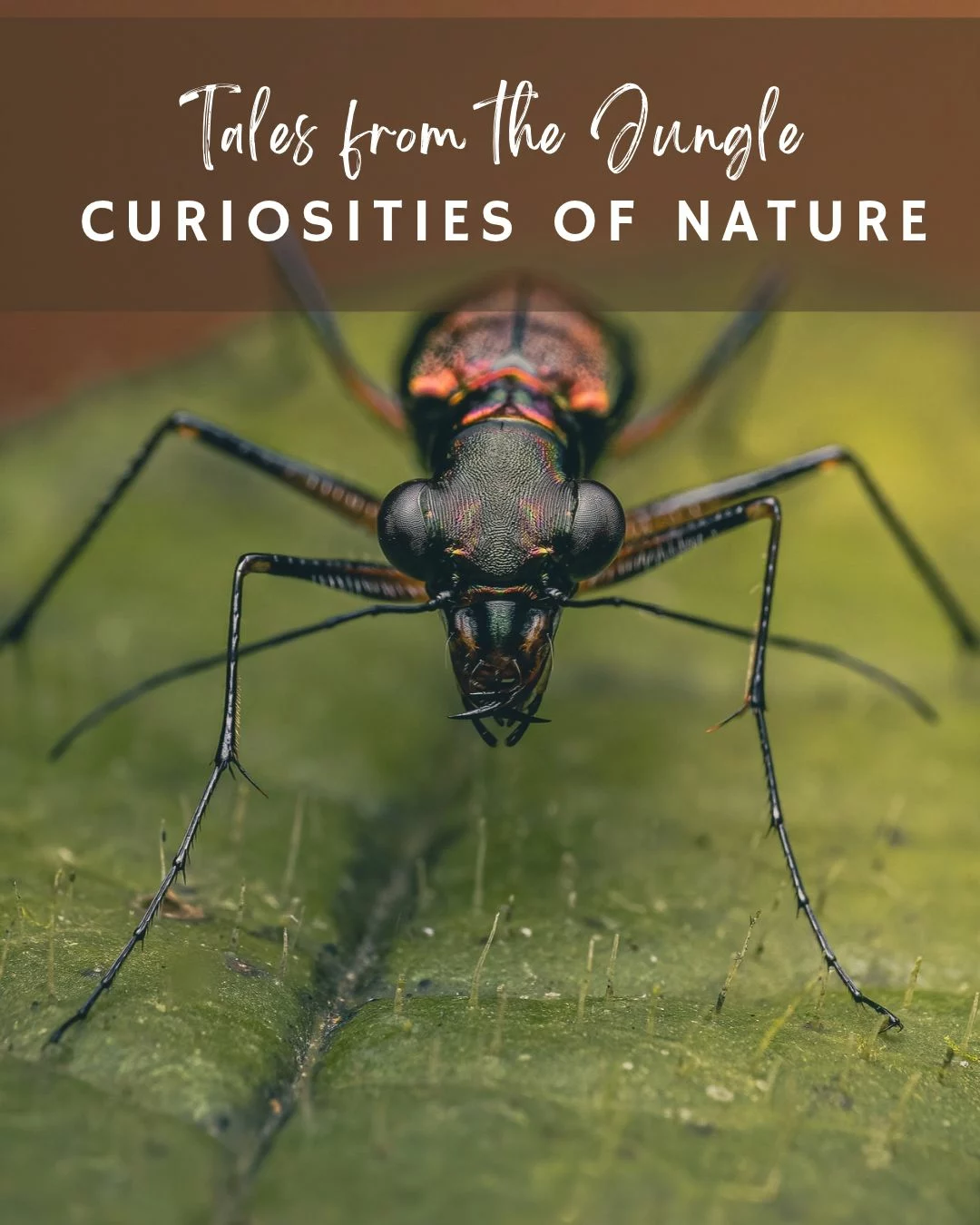
I have always been fascinated by tiger beetles.
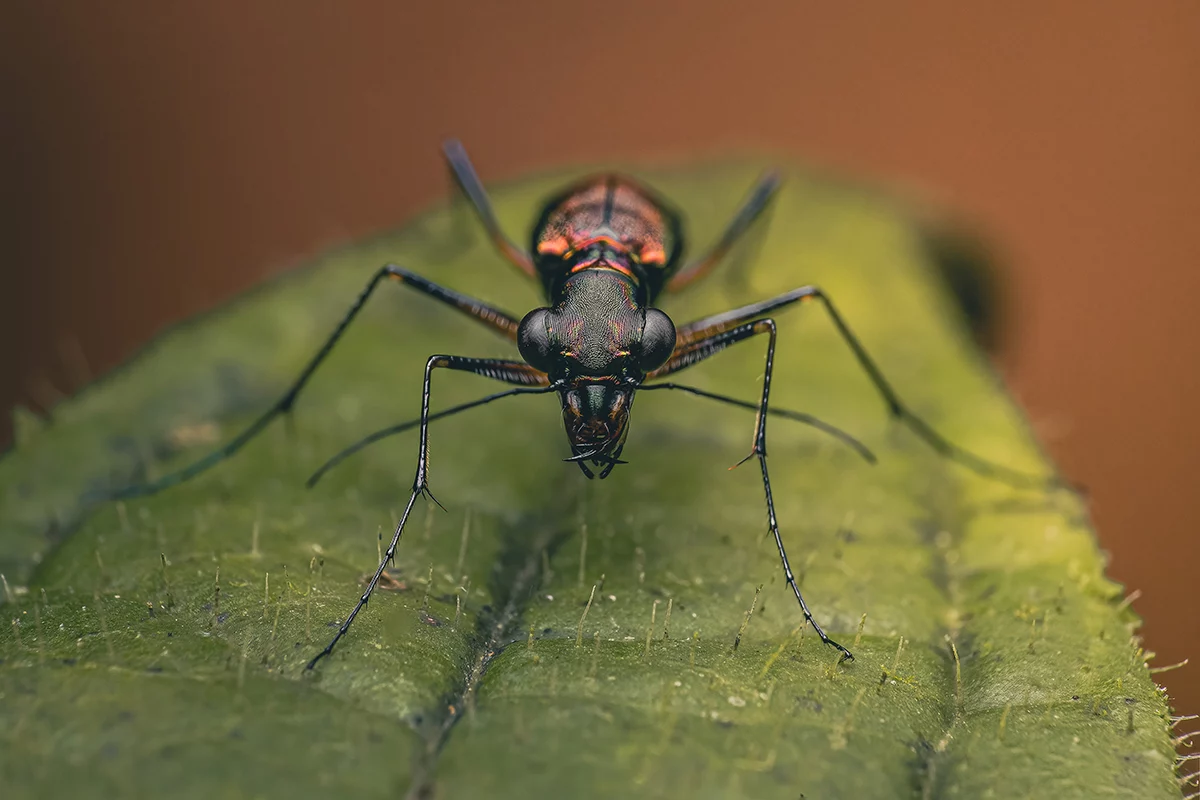
They are beautiful little predators, often metallic and brightly colored, with long legs built for running.
But there is something about them that is even more fascinating once you know what they are capable of.
They are incredibly fast.
And not just fast for their size.
Some tiger beetles can run at more than 100 times their own body length per second. The fastest known species can reach around 9 kilometers per hour — which doesn’t sound particularly impressive until you remember that the animal doing it is only a few millimeters long.
For a human, running at the equivalent relative speed would be extraordinary.
For a tiger beetle, it is part of the way it hunts.
These beetles are visual predators. They spot their prey and chase it across relatively open ground, relying on their eyes to guide their movements.
It sounds like a very simple strategy:
See the prey.
Run toward it.
Catch it.
But there is a problem.
The faster the beetle runs, the harder it becomes for it to see.
At high running speeds, the movement of the beetle itself creates enough motion blur to degrade the image of its prey. The visual information becomes less reliable, and eventually the beetle can no longer properly locate what it was chasing.
And this is where tiger beetles become particularly fascinating.
They don’t simply slow down.
They stop.
For a moment, the beetle pauses, locates the prey again, adjusts its direction, and then accelerates.
Run.
Stop.
Look.
Run again.
During a pursuit, this can happen several times before the beetle finally reaches its prey.
At first glance, it seems almost inefficient.
Why would an animal that has evolved such extraordinary speed interrupt that speed every few moments?
But the stop is not a failure of the system.
It is part of the system.
The beetle’s speed gives it the ability to close the distance quickly, while the brief pauses allow its visual system to catch up.
In other words, the beetle has evolved a way to work around the limitations created by its own speed.
And there is another fascinating part of the story.
If the beetle’s vision becomes unreliable while it is running, how does it avoid crashing into things?
This is where its antennae become important.
Researchers found that tiger beetles use their forward-pointing antennae to detect obstacles while running. Even when their eyes were covered, beetles could still respond to obstacles when their antennae touched them. Their antennae essentially provide another way of gathering information about the environment when vision is compromised by speed.
I love this kind of biological solution.
Because it reminds me that adaptations rarely exist in isolation.
A trait evolves because it solves a problem.
But pushing that trait to an extreme can create new problems.
Speed helps the beetle catch its prey.
But speed also makes it harder to see.
So the beetle has another solution: stop briefly, regain visual information, and continue.
And while running, when its eyes cannot provide all the information it needs, its antennae help it negotiate the world directly in front of it.
It is almost as if the animal has built a series of workarounds around its own success.
That is one of the things I find so endlessly fascinating about evolution.
We sometimes talk about adaptations as though an animal simply receives the perfect body for the environment in which it lives.
But evolution is rarely that simple.
It is more like a continuous negotiation.
A change creates an advantage.
That advantage creates new possibilities.
And sometimes those possibilities come with new limitations that have to be solved in another way.
The tiger beetle is a beautiful example of this.
Its incredible speed is not simply a remarkable physical ability.
It has consequences for the way the animal sees, moves, hunts and interacts with its surroundings.
And somehow, all of those systems have to work together.
The next time I see a tiger beetle running across the ground, I will probably think about it differently.
Not just as a beautiful metallic beetle.
Not just as a fast predator.
But as an animal constantly balancing speed and perception — sprinting through a world that can literally become a blur when it moves too quickly.
And perhaps that is one of the most interesting things evolution can teach us:
Sometimes the most extraordinary adaptations come with problems of their own.
And life finds a way to solve those, too.


Leave A Comment